

Site Dumper Fuel Efficiency and Daily Operating Costs
Site dumpers do much of the hauling on a construction project. They carry soil, aggregate, concrete, and demolition waste across sites where larger haul trucks can’t fit or travel safely, such as narrow access routes, soft ground, and congested work zones. Because they run trip after trip all day, small inefficiencies add up quickly. A few minutes of idling per cycle, a poorly planned route, or an underinflated tire may seem minor on a single trip. Over a full shift and an entire project, those losses become a measurable cost.
Site dumper fuel efficiency is only one part of the daily operating cost. Load size, travel distance, ground conditions, idle time, tire or track condition, operator habits, and maintenance all affect what it costs to move each load. Two identical dumpers on the same site can have very different running costs depending on how they’re loaded, routed, and maintained.
Understanding Fuel Consumption During Material Transport
A site dumper burns fuel throughout its working cycle, not just while it’s carrying material. The engine consumes fuel during loading, loaded travel, tipping, return travel, and every period of waiting in between. Understanding where that fuel goes is the first step toward controlling it.
Several factors determine how much fuel a dumper uses:
- Engine size and condition: Larger engines use more fuel per hour, and a poorly maintained engine burns more than one in good condition.
- Load weight: A loaded dumper works harder than an empty one, especially on climbs and soft ground.
- Terrain: Steep ramps, mud, loose sand, and rutted haul roads increase engine demand and rolling resistance.
- Travel speed: Running at high engine speed on short trips wastes fuel without saving meaningful time.
- Stop-start frequency: Repeated acceleration from a standstill uses more fuel than steady travel.
- Idle time: An idling engine consumes fuel while moving no material at all.
General consumption figures from brochures or other jobs give only a rough guide. The most reliable number comes from your own site. Record the fuel added at each fill and the engine hours from the hour meter. Over several representative shifts, divide the fuel used by the hours worked to establish a real consumption rate for that machine in those conditions.
Key takeaway: Fuel use depends on engine condition, load, terrain, speed, stop-start travel, and idling, so measure actual consumption on your own site rather than relying on general estimates.
Calculating Fuel Cost per Working Day
Once you know the dumper’s real consumption rate, calculating daily fuel cost is straightforward. Multiply the fuel used during the shift by the price you pay per gallon or liter.
Keep Records That Make the Number Useful
A single day’s figure can be misleading. Rain, an unusually long haul route, or a delay at the loading point can push consumption up or down. Track fuel cost over representative periods and record:
- Engine hours and fuel added
- Number of load cycles completed
- Haul distance and route conditions
- Weather and ground conditions
- Any downtime or unusual delays
These records let you compare costs between projects, spot a machine whose consumption is creeping upward, and build more accurate estimates for future bids.
Key takeaway: Multiply measured fuel use by your fuel price to find daily fuel cost, and keep records of hours, cycles, and site conditions so the figure becomes a reliable basis for comparison and estimating.
How Load Weight and Trip Distance Affect Expenses
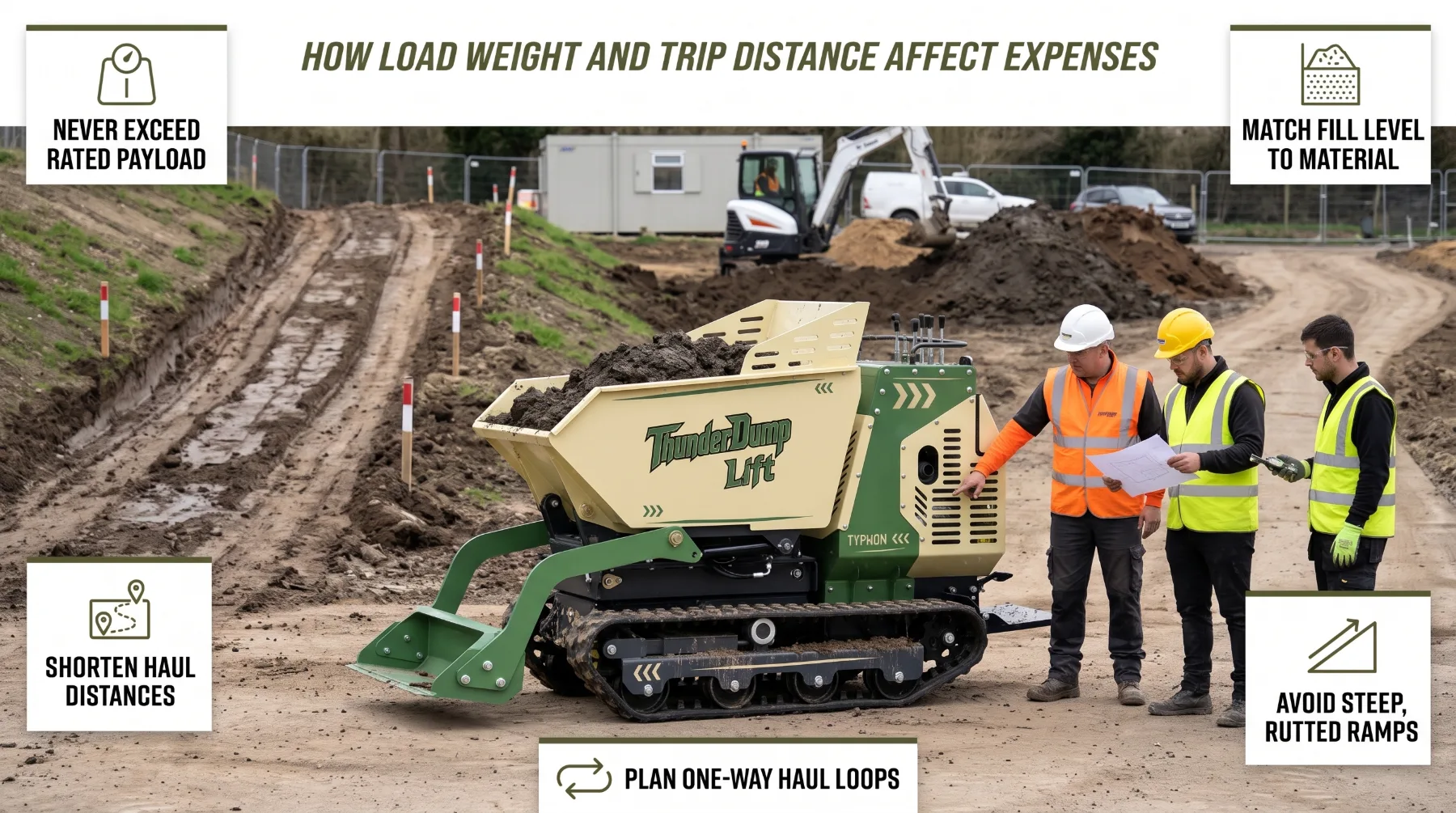
Every trip a dumper makes costs fuel, operator time, and machine wear. The goal is to move the required material in as few efficient trips as practical, without ever exceeding the machine’s rated payload.
Load Size
Carrying a suitable load on each trip reduces the total number of trips. A dumper that consistently runs half full may need nearly twice as many cycles to move the same volume, which roughly doubles the travel time and much of the fuel cost for that work.
Overloading is not the answer. Exceeding the rated payload affects stability, braking, and steering, and it accelerates wear on tires, axles, the skip, and the frame. Overloaded dumpers are also more likely to tip on slopes or uneven ground. Material density matters here: a skip filled level with wet clay or crushed concrete may weigh far more than the same volume of dry topsoil. Check the manufacturer’s rated payload and adjust fill levels to suit the material.
Trip Distance and Route
Distance drives fuel cost directly, and route quality drives it further. A short route that climbs a steep ramp or crosses deep mud can cost more than a longer route on firm, level ground. To reduce travel expenses:
- Position loading and tipping points as close together as safe working allows.
- Keep haul routes firm, graded, and clear of debris, potholes, and standing water.
- Avoid steep gradients where a gentler alternative exists.
- Reduce tight turns and reversing by planning one-way loops where space permits.
- Separate dumper routes from pedestrians to cut stops and improve safety.
Route planning pays off quickly. Shaving even a small distance from a route that the dumper runs dozens of times per shift produces savings that build every day of the project.
Key takeaway: Fill each load appropriately for the material without exceeding rated payload, and plan short, firm, well-maintained haul routes to reduce the fuel and time cost of every trip.
Reducing Fuel Waste During Idle Periods
Idle time is one of the most common and least visible sources of fuel waste. A dumper sitting with its engine running while it waits for an excavator, a concrete pour, or a gap in site traffic consumes fuel without moving any material. It also adds engine hours, which bring service intervals closer.
Much of this waste comes from poor coordination rather than operator choice. Practical ways to reduce it include:
- Match dumper numbers to loading capacity. Too many dumpers waiting on one excavator creates queues. Too few leaves the excavator waiting instead.
- Coordinate with loading and tipping crews so the dumper arrives as the bucket is ready.
- Shut down during longer waits when the manufacturer’s instructions and site rules allow it.
- Follow the manufacturer’s warm-up and shutdown guidance rather than extended idling at the start and end of the day.
- Avoid unnecessary revving and use travel speeds suited to the terrain.
Some machines record idle time through telematics or onboard displays. Where this data is available, review it regularly. It often reveals patterns, such as long waits at a particular loading point, that a small change in scheduling can fix.
Key takeaway: Idling burns fuel and adds engine hours without moving material, so coordinate loading and tipping, shut down during longer waits where permitted, and use idle data to correct recurring delays.
Including Maintenance in Daily Operating Costs
Fuel is the most visible daily expense, but it’s far from the only one. A complete operating cost includes the service, wear, and repairs that keep the dumper running. Ignoring these costs makes a machine look cheaper to operate than it really is.
Typical maintenance cost items include:
- Engine oil, filters, and fluids replaced on the manufacturer’s schedule
- Hydraulic fluid and filters for the skip tipping and steering systems
- Tires or tracks, which wear faster on abrasive or rough haul roads
- Brakes and steering components
- Cooling system parts, including radiator cleaning and coolant
- Wear-related repairs to the skip, pivot pins, and frame
- Service labor, whether in-house or from a dealer
Maintenance also affects fuel use directly. Underinflated tires increase rolling resistance, clogged air filters restrict engine breathing, and a dirty radiator can cause the engine to run hot. Daily pre-operation checks catch these issues early. Follow the manufacturer’s service schedule, record every part, repair, and labor hour, and treat rising maintenance costs as a signal to investigate before a breakdown causes downtime.
Key takeaway: Convert maintenance spending into an hourly allowance and add it to fuel cost, because filters, fluids, tires, repairs, and labor are real daily expenses that also influence fuel efficiency.
Measuring Cost per Load and Material Volume
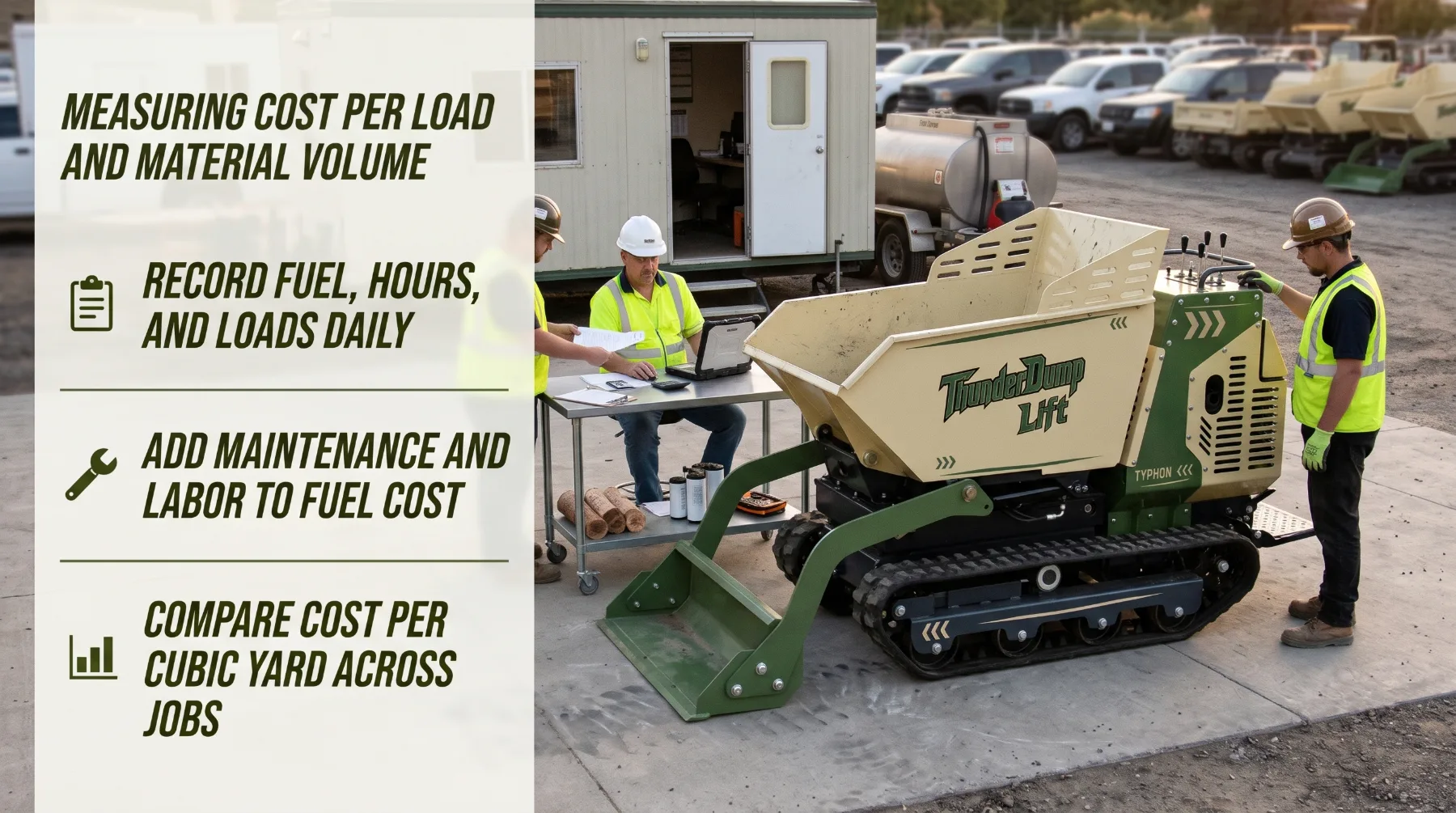
Daily cost shows what a dumper spends. It doesn’t show how efficiently that money moves material. Cost per load and cost per cubic yard reveal the true productivity of the machine and the operation around it.
These figures make meaningful comparisons possible. If the same dumper completes only 40 loads the next day because of a longer route or loading delays, cost per cubic yard rises to $4.20, even though daily fuel cost barely changed. That difference points directly to the problem.
When comparing jobs or machines, account for differences in haul distance, material density, ground conditions, and loading equipment. Use cost per volume to check whether a dumper’s payload suits the work, to estimate transport costs on future bids, and to decide whether a larger machine, a second dumper, or a better route would reduce total cost.
Key takeaway: Divide total operating cost by loads or cubic yards moved to measure true transport efficiency, then use those figures to compare jobs, refine estimates, and identify where productivity is slipping.
Conclusion
Site dumper operating costs depend on far more than the fuel gauge. Measuring real fuel consumption on your own site gives you a reliable starting point, and a simple calculation turns that into an accurate daily fuel cost. Load weight, trip distance, route condition, and idle time all shape how much each trip costs, while maintenance adds a real hourly expense that also influences fuel efficiency. Cost per load and cost per cubic yard bring these factors together and show how productively the machine moves material. Start by recording fuel added, engine hours, and loads completed for one week. Then review your haul routes, loading coordination, and maintenance records, and calculate cost per cubic yard so you can make informed decisions that keep your dumpers productive, safe, and within their rated limits.
Frequently Asked Questions
What affects site dumper fuel consumption most?
Fuel consumption depends on several factors working together. Load weight, travel distance, terrain, engine condition, travel speed, and idle time all play a major role. Steep ramps, soft ground, and rough haul roads make the engine work harder, while frequent stops and long idle periods burn fuel without moving material. Poor maintenance, such as underinflated tires or clogged filters, also increases consumption. Recording fuel use and engine hours on your own site shows which factors matter most for your operation.
How can contractors calculate daily fuel cost?
Multiply the amount of fuel the dumper used during the shift by the price paid per gallon or liter. For example, a machine that runs 7 hours at 1.2 gallons per hour uses 8.4 gallons, and at $4.00 per gallon the daily fuel cost is $33.60. For accuracy, measure consumption over several representative shifts by recording fuel added and hour meter readings, rather than relying on a single day or a general estimate.
Does carrying a full load always improve fuel efficiency?
A suitable load reduces the number of trips needed to move material, which usually lowers fuel cost per cubic yard. However, the dumper must never exceed its rated payload. Dense materials such as wet clay or crushed concrete can reach the weight limit before the skip is full. Overloading affects stability, braking, and steering, and it accelerates wear on tires, axles, and the frame. Match fill levels to the material and the manufacturer’s rated payload.
Should maintenance be included in dumper operating costs?
Yes. Engine oil, filters, hydraulic fluid, tires or tracks, brakes, cooling components, repairs, and service labor are all part of the cost of running a dumper. A practical method is to total maintenance spending over a period and divide it by engine hours to create an hourly allowance. Adding that allowance to fuel and labor gives a complete daily cost, which supports accurate cost-per-load calculations and better project estimates.