

Mini Excavator Double-Side Throttle Valve vs Three-Way Stop Valve
Hydraulic attachments can require different circuit configurations to operate correctly, especially when a mini excavator switches between tools such as breakers and hydraulic thumbs. A thumb that fails to close may not have a mechanical problem at all. The auxiliary circuit may be configured for a single-acting attachment when the installed tool requires hydraulic pressure in both directions.
Stop valves and throttle valves serve different purposes within a hydraulic system. A stop or selector valve can direct hydraulic oil to the appropriate return path or configure the circuit for a specific attachment, while a throttle valve restricts flow to control actuator speed. Selecting the correct valve type, circuit arrangement, and attachment compatibility is important for maintaining proper hydraulic function and avoiding unnecessary attachment stress.
Before installing or switching attachments, operators should confirm the required hydraulic circuit configuration and make sure the valve settings match the tool being used. Flow-control valves should also be adjusted so the attachment moves smoothly rather than too quickly or abruptly, while hoses, fittings, and valves should be checked regularly for leaks or damage. Understanding how each valve controls hydraulic flow makes troubleshooting easier and supports safer, more precise attachment operation.
Double-Side Throttle Valve Design
A double-side throttle valve controls the rate of hydraulic flow in both directions through a circuit. It doesn’t decide where fluid goes. It decides how quickly fluid can pass. By narrowing the flow path, the valve slows the movement of the cylinder or motor it serves. That gives the operator smoother, more predictable motion.
The core of the valve is a restriction, often called an orifice or throttle. Many designs use an adjustable needle or spool. Turning the adjuster opens or closes the passage, which raises or lowers the flow rate. Some valves use a fixed orifice sized for a specific speed. Others pair throttles with check valves, so each direction can be set on its own. The details vary by manufacturer, so always review the valve’s documentation.
On a cylinder, a double-side throttle valve affects both extension and retraction. That matters for attachments such as thumbs, tilt mechanisms, and other tools that move in two directions. If a cylinder moves too fast in either direction, the throttle can tame it. The result is better control, less shock through pins and mounts, and less risk of damaging the material being handled.
Restricting flow has trade-offs. Narrowing the passage creates heat and a pressure drop across the valve. An over-restricted setting can make an attachment sluggish, raise fluid temperature, and add strain to the system. The goal is the smoothest motion that still meets the task, not the slowest motion possible. Adjustments should follow the attachment and valve manufacturers’ guidance.
Key takeaway: A double-side throttle valve restricts hydraulic flow in both directions, helping control the speed and smoothness of cylinder extension and retraction without changing where the fluid goes.
Three-Way Stop Valve Design
A three-way stop valve has three connection ports and controls how fluid moves between them. Instead of adjusting flow speed, it opens, closes, or redirects flow paths. Depending on its internal design and position, it can connect one port to either of the other two. It can also block flow entirely.
Many three-way valves on mini excavators use a ball-type design with a lever or handle. Turning the handle rotates a bored ball inside the body, which lines up different ports. Common internal patterns include L-port and T-port arrangements, and each one routes fluid differently. The valve body is usually marked with port labels or flow indicators. Those markings matter during installation and operation.
The most familiar use on a mini excavator is auxiliary circuit selection. A hydraulic breaker typically needs its return oil to flow with little restriction back to the tank. A two-way attachment, such as a thumb or tilt bucket, needs oil to flow under pressure in both directions. A three-way stop valve can switch the return line between those two paths. One machine can then run both types of tools.
Because the valve directs flow, its position must match the attachment in use. The wrong position can stop an attachment from working, cause it to work in one direction only, or send flow somewhere it shouldn’t go. Operators should know what each handle position does on their machine. They should also confirm the setting every time they change attachments.
Key takeaway: A three-way stop valve manages flow between three connection points, allowing fluid to be blocked, routed, or redirected so one circuit can serve different attachment requirements.
Installation and System Compatibility
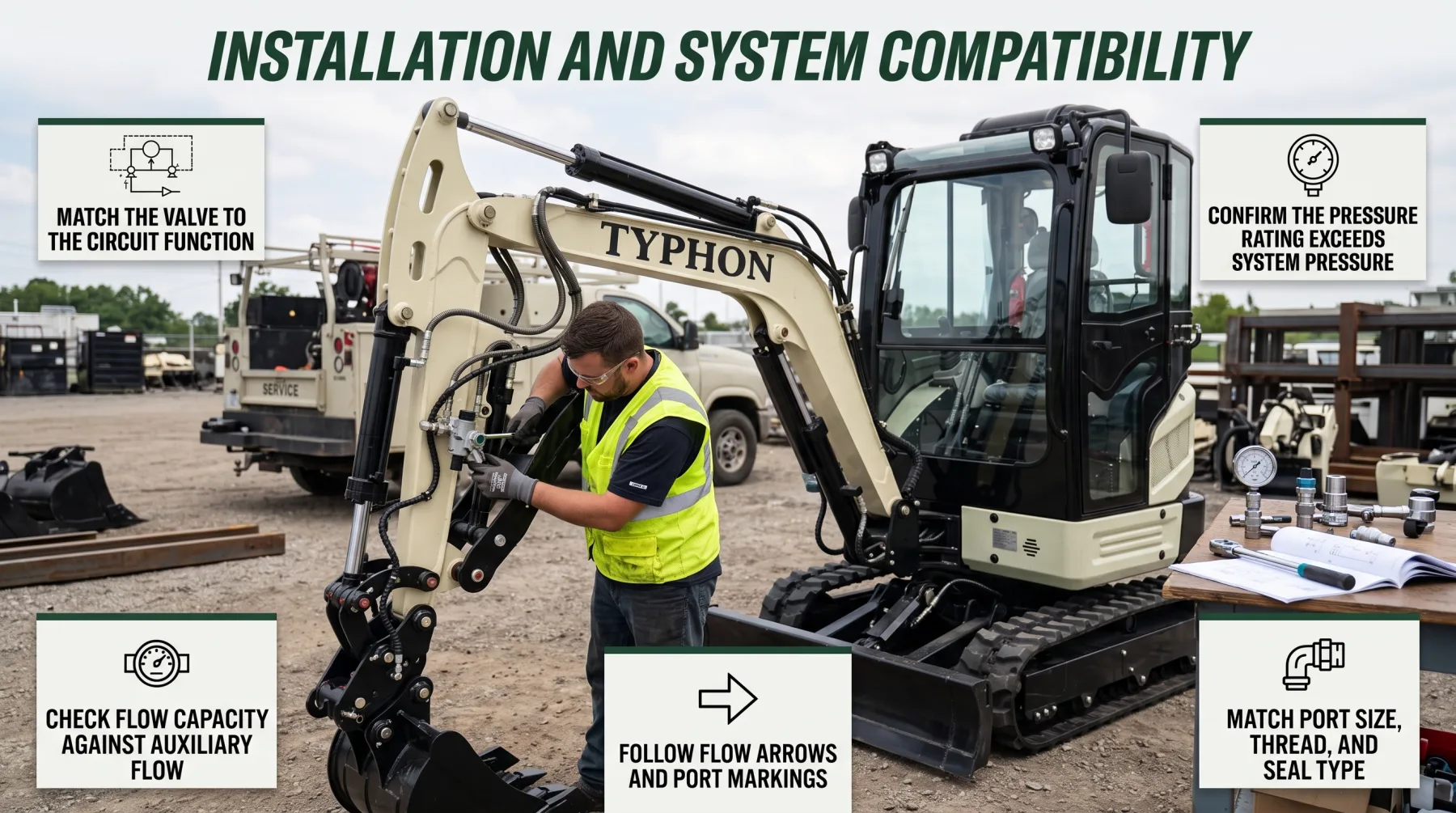
A hydraulic valve needs to match the machine’s circuit, pressure, flow, connections, and operating requirements to work reliably. Selecting the wrong valve can restrict flow, create heat, cause leaks, or lead to component failure. Proper installation and system checks help protect the machine and attachment.
- Circuit Compatibility: Match the valve type and function to the hydraulic circuit and attachment requirements.
- Pressure Rating: Make sure the valve’s maximum working pressure meets or exceeds the highest pressure the system can produce.
- Flow Capacity: Select a valve that can handle the machine’s hydraulic flow without creating excessive restriction or heat.
- Ports & Connections: Confirm port size, thread type, seal method, and connection requirements before installation.
- Flow Direction & Installation: Follow valve markings and flow direction, relieve hydraulic pressure before installation, and test the system carefully after fitting.
Key takeaway: Match every valve to the circuit’s function, pressure, flow, port configuration, and flow direction, since a mismatched valve can affect hydraulic performance or create an unsafe operating condition.
Hydraulic Flow Control Differences
The main difference between these valves is the question each one answers. A double-side throttle valve answers “how fast?” A three-way stop valve answers “which way?” Both control hydraulic flow, but they work on different parts of the problem.
The throttle valve works on flow rate. It keeps the same path open and narrows it, so less fluid passes in a given time. Its effect is gradual and adjustable. A small change to the setting produces a small change in speed. That makes it a precision tool for motion control.
The stop valve works on the flow path. It acts more like a switch than a dial. In one position, fluid follows one route. In another position, it follows a different route or stops completely. A three-way stop valve is generally not designed to meter flow, and using a partially opened ball valve as a throttle can cause wear, heat, and unpredictable behavior. Each valve should do the job it was built for.
These differences explain why both valves can appear in the same machine without overlap. A contractor might use a three-way stop valve to set the auxiliary circuit for a two-way thumb. A double-side throttle valve might then set how quickly that thumb opens and closes. Understanding each valve’s role makes troubleshooting faster. If an attachment doesn’t move at all, check flow routing first. If it moves too quickly or too slowly, look at flow restriction.
Key takeaway: A double-side throttle valve regulates how fast fluid moves in two directions, while a three-way stop valve controls which path fluid takes, so their functions depend on what the circuit requires.
Application in Mini Excavator Systems
Mini excavators rely on hydraulics for nearly every function. The boom, arm, bucket, swing, travel, blade, and auxiliary tools all depend on controlled fluid flow. Additional valves like these are usually added to specific circuits where the standard control valve needs support. The exact use depends on the machine and how it’s configured.
Auxiliary circuits are the most common home for both valve types. A three-way stop valve is often fitted on the stick or near the auxiliary lines. There it switches between single-acting tools, such as breakers, and double-acting tools, such as thumbs, augers, and tilt buckets. This lets a contractor run a wider range of attachments from one machine without re-plumbing hoses for every change.
A double-side throttle valve suits circuits where attachment speed matters more than raw output. A thumb that closes too quickly can crack stone, crush pipe, or jolt the machine. A tilt mechanism that moves too fast can make fine grading harder. Slowing these functions in both directions improves control near structures, finished surfaces, and workers on foot.
Stop valves may also isolate a section of circuit for safe attachment changes or service, depending on the system design. Whatever the application, these valves should support the manufacturer’s hydraulic design, not work against it. Changes to factory circuits should be planned with the machine manufacturer, the attachment supplier, or a qualified hydraulic technician. That keeps relief settings, return flow requirements, and operating pressures within safe limits.
Key takeaway: Both valve types are used where specific circuits need flow routing or speed control, especially auxiliary circuits that run breakers, thumbs, augers, and other attachments.
Inspection and Maintenance
Hydraulic valves work quietly in the background, so problems can build before anyone notices. A few minutes of regular inspection keep flow routing accurate and speed control consistent. They also reduce the chance of a larger system failure.
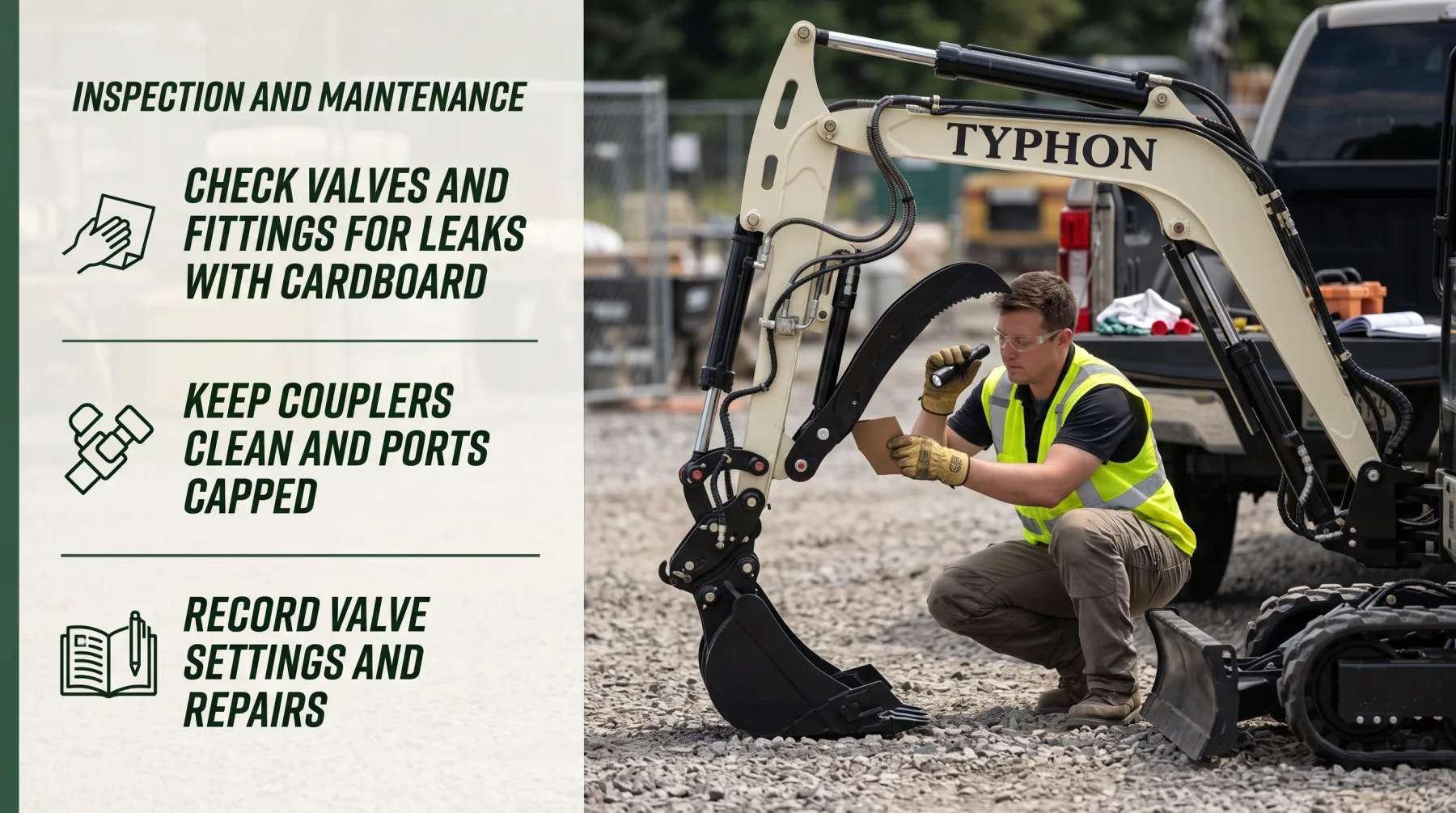
Inspect each valve and its connections during the daily walkaround. Look for fresh oil, dust-caked residue, and dampness around the valve body, fittings, and adjustment points. Check hoses near the valve for abrasion, kinks, and rubbing, since valves on the stick sit in a high-movement area. Never check for leaks by running your hand along a hose or fitting. Pressurized fluid can penetrate skin and cause serious injury that needs immediate medical care. Use a piece of cardboard instead.
Watch how the valves behave during work. A three-way stop valve handle that’s stiff, loose, or won’t stay in position can point to internal wear or contamination. A throttle valve that no longer holds its setting, or an attachment that speeds up or slows down without any change, suggests a problem with the adjuster or internal parts. Attachments that move unevenly, drift, or respond only in one direction also deserve attention. Stop and have the system inspected before continuing.
Contamination is a common cause of valve problems. Dirt can score internal surfaces, block small throttle passages, and damage seals. Wipe auxiliary couplers and fittings clean before every connection, and keep caps or plugs on open ports. Follow the manufacturer’s schedule for hydraulic fluid and filter changes. Use only the fluid the manufacturer specifies.
When seals or components are damaged, replace them with parts rated for the system. Relieve pressure according to the manufacturer’s procedure before loosening any fitting. Record valve settings, repairs, and replacements in the maintenance log, so the next technician knows how the circuit was set.
Key takeaway: Check hydraulic valves regularly for leaks, damaged fittings, contamination, and unusual operation, and repair damaged seals or components promptly to maintain proper hydraulic flow.
Conclusion
Double-side throttle valves and three-way stop valves control hydraulic flow in different ways, so understanding their functions helps support reliable attachment operation and troubleshooting. A double-side throttle valve regulates flow in both directions, allowing smoother and more controlled actuator movement, while a three-way stop valve directs or isolates flow between three connection points for different hydraulic circuits or attachment configurations. Before changing attachments, operators should lower all equipment to the ground, confirm the three-way valve position and double-side throttle setting, and record the correct configuration for future use. Valve bodies, fittings, adjusters, and nearby hoses should be inspected for leaks, abrasion, kinks, and rubbing, with cardboard used instead of hands when checking for pressurized leaks. Couplers and fittings should be cleaned before connection, and attachment movement should be tested at low speed to confirm smooth and correct operation in both directions. Hydraulic fluid level and condition should also be checked, while valve positions, settings, and repairs should be recorded in the maintenance log. Proper valve selection, installation, adjustment, and routine inspection help maintain predictable hydraulic performance during attachment changes and daily mini excavator oper
Frequently Asked Questions
What does a double-side throttle valve do?
A double-side throttle valve restricts hydraulic flow in both directions, helping regulate the speed of hydraulic cylinders and other components. By controlling the rate of fluid movement, it can provide smoother and more predictable attachment or cylinder operation. Proper adjustment should match the machine’s hydraulic circuit and the requirements of the connected function.
What is the purpose of a three-way stop valve?
A three-way stop valve manages hydraulic flow between three connection points and can block or redirect fluid within the circuit. On some mini excavators, it can be used to switch an auxiliary hydraulic circuit between single-acting and double-acting attachment functions. Its exact application depends on the machine’s hydraulic configuration.
Are these two valves interchangeable?
No. Their functions, connection arrangements, and roles within the hydraulic circuit are different. A double-side throttle valve regulates flow speed, while a three-way stop valve controls the direction or path of hydraulic flow. The correct valve must match the excavator’s hydraulic system and the intended attachment function.
Why is valve maintenance important?
Hydraulic valves need to remain clean and properly sealed to maintain consistent fluid flow. Leaks, contamination, damaged fittings, or worn components can interfere with hydraulic pressure and attachment response. Regular inspection helps identify problems early and supports predictable, controlled operation of the mini excavator’s hydraulic functions.