
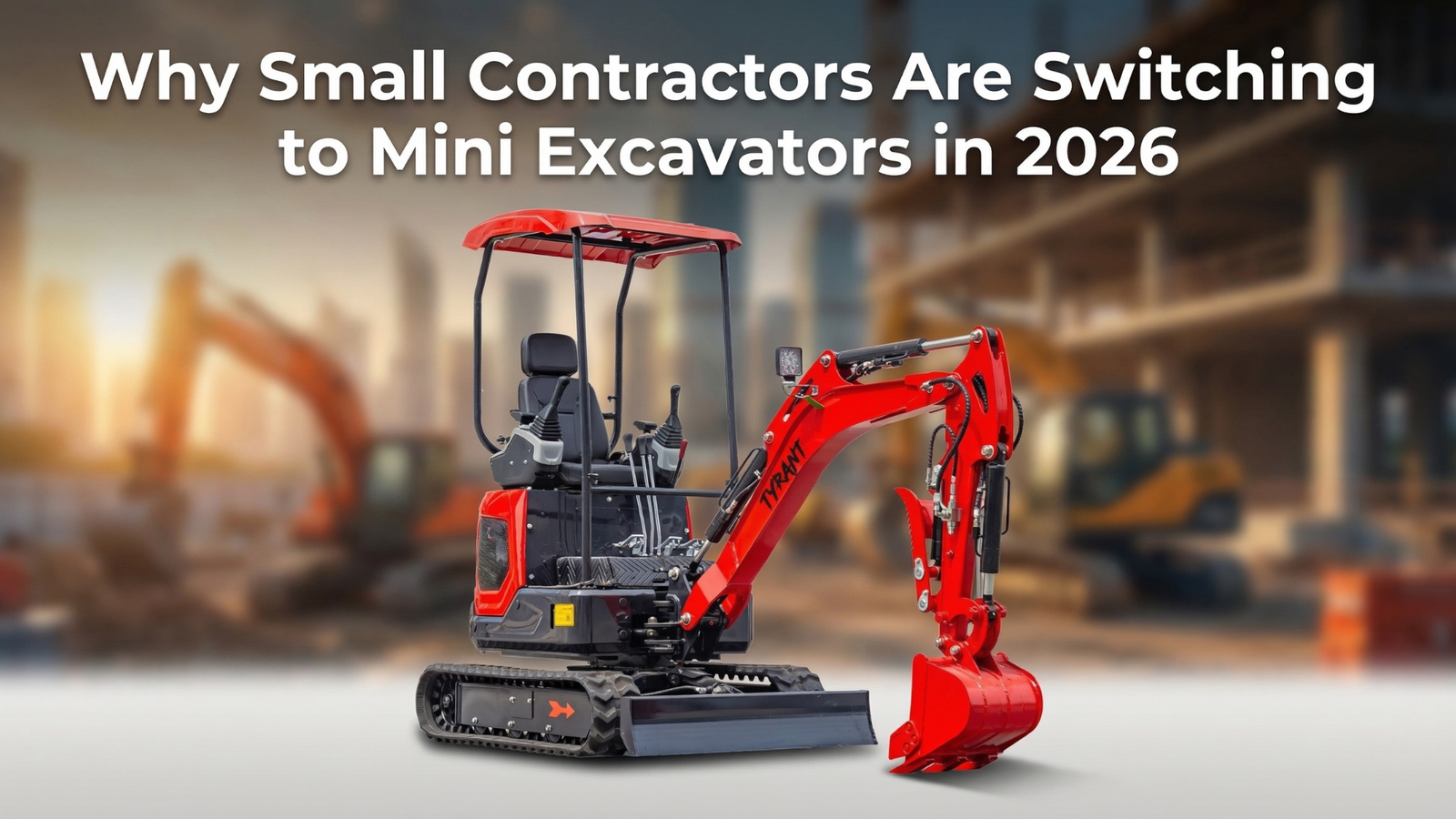

A big change is happening on job sites across the country. Many small contractors in construction and landscaping are starting to change the way they choose their equipment. In the past, most crews relied on a powerful skid steer loader and several workers to handle the job. Now, more contractors are making the mini excavator the main machine they use. In 2026, this shift is not just a trend—it’s a smart business move because of the machine’s efficiency, lower costs, and flexibility.
Small contractors face many challenges today. Labor costs are rising, skilled workers are harder to find, and competition between companies is strong. Because of this, simply adding more workers to a job is no longer the best solution. Many contractors are realizing that a mini excavator can handle a lot of tasks quickly and accurately. This allows them to finish jobs faster while using a smaller crew.
For contractors who want to stay competitive, understanding this change is important. This guide explains why more small contractors are choosing mini excavators and looks at the key benefits that are driving this growing trend.
Unlocking Unmatched Versatility on the Job Site
The primary driver behind the mini excavator’s rise is its incredible versatility. Small contractors rarely perform the same task all day. A single project might involve digging footings, trenching for utilities, demolishing a concrete patio, and placing landscape boulders. In the past, this would require multiple specialized machines or a large, multi-skilled crew. The mini excavator consolidates these functions into one compact platform.
With a quick-coupler system, an operator can switch between a digging bucket, a hydraulic breaker, a grading blade, and an auger in minutes. This ability to adapt on the fly is a game-changer for small teams. The machine is no longer just an excavator; it becomes a mobile power unit for a whole suite of attachments. This reduces the need to own or rent multiple pieces of equipment, streamlining logistics and lowering overall operational costs. A contractor can arrive at a job site with one machine and a trailer of attachments, prepared for nearly any task the project demands.
This versatility also allows contractors to expand their service offerings. A landscaping company that once focused on lawn installation can now confidently bid on projects involving drainage systems or small foundation work. This diversification creates new revenue streams and makes the business more resilient to market fluctuations.
The Financial Case: Drastically Reducing Labor Costs

Labor is consistently the largest and most unpredictable expense for any small contractor. The financial and logistical burden of managing a large crew is substantial. A mini excavator directly confronts this challenge by acting as a force multiplier, enabling one skilled operator to accomplish the work of several manual laborers.
Consider the task of digging a 100-foot trench for an irrigation line. A crew of four laborers with shovels might take an entire day to complete the job, especially in compacted or rocky soil. The direct cost, including wages, payroll taxes, and insurance, can easily approach a thousand dollars. A single operator in a mini excavator can typically complete the same trench in just a few hours. The total cost, including the operator’s wage and the machine’s operating expense, is a fraction of the manual labor cost.
These savings are not just theoretical; they are realized on every project. The machine doesn’t get tired, it doesn’t call in sick, and it doesn’t suffer from fatigue-related injuries. This reliability allows for more accurate job costing and predictable project timelines, which are essential for maintaining profitability. By reducing their dependency on manual labor, contractors are building more stable and scalable business models.
Dominating Tight Spaces with Surgical Precision
Modern construction and renovation projects are increasingly taking place in dense urban and suburban environments. Lot sizes are shrinking, and access is often restricted. This is where the compact footprint of a mini excavator provides a decisive advantage over larger equipment like a traditional backhoe loader.
These machines are designed to work in confined spaces. Many models feature a zero-tail-swing or short-tail-swing design, which means the machine’s upper structure can rotate within the width of its own tracks. This allows an operator to dig right alongside a building, wall, or other obstacle without the risk of an accidental collision. They can navigate through narrow gates and operate in tight backyards, opening up a whole category of jobs that are inaccessible to larger equipment.
This precision is not limited to just fitting into tight spaces. The hydraulic controls of a modern mini excavator offer incredibly smooth and precise boom and arm movements. This allows operators to carefully dig around sensitive underground utilities, create clean, sharp edges for foundations, and delicately place heavy objects. This level of control minimizes rework and reduces the risk of costly damage to existing infrastructure.
Boosting Efficiency and Accelerating Project Timelines

In the contracting business, time is money. The faster a project can be completed, the sooner the final invoice can be sent, and the next job can begin. The mini excavator is an engine of efficiency, accelerating nearly every phase of a project.
The machine’s ability to perform a 360-degree swing is fundamental to its speed. An operator can dig material from a hole and, with a quick rotation, deposit it directly into a dump truck or a specific location on site without having to reposition the entire machine. This fluid cycle of dig-swing-dump is dramatically faster than the multi-point turns required by a tractor loader backhoe or the manual process of loading wheelbarrows.
This increased speed has a cascading effect on the entire project schedule. When excavation work is completed ahead of schedule, it allows plumbers, electricians, and other trades to get started sooner. For the contractor, faster project turnover means the ability to complete more jobs within a single season, significantly boosting annual revenue. A contractor who can consistently deliver projects on or ahead of schedule also builds a powerful reputation for reliability, which is a key differentiator in a crowded market.
Conclusion
The movement toward mini excavators among small contractors in 2026 is a clear-eyed response to the economic and operational pressures of the modern construction industry. These machines are not just another piece of yellow iron; they are a strategic solution that addresses the core challenges of labor costs, job site access, and operational efficiency.
By investing in a mini excavator, contractors are equipping themselves with a versatile tool that can replace multiple single-purpose machines and reduce their reliance on expensive manual labor. They are gaining the ability to work in tight spaces where competitors cannot, and they are accelerating project timelines to improve both profitability and client satisfaction. For the small contractor looking to grow, the question is no longer whether they can afford a mini excavator, but whether they can afford not to have one.