

How Travel Distance Affects Electric Scissor Lift Runtime
Travel distance has a direct effect on the energy consumed by an electric scissor lift during a work shift. The drive motors draw electrical current whenever the machine accelerates, maintains movement, or climbs an incline, and that energy comes from the same battery used by the lifting and auxiliary systems. Longer travel distances therefore increase total energy consumption even when the platform is not being raised. The effect becomes greater when the lift carries a heavy platform load, operates on rough or sloped surfaces, or requires frequent starts, stops, and direction changes because these conditions increase traction motor torque and current demand.
Travel efficiency depends on more than total distance alone. Surface resistance, tire condition, platform load, travel speed, gradients, and the frequency of repositioning all influence how much energy each drive cycle requires. Repeatedly moving between widely separated work areas can consume a significant portion of available battery capacity, particularly on large or uneven jobsites. Planning work zones to reduce unnecessary travel, maintaining correct tire pressure, avoiding excessive acceleration, and positioning the lift closer to the active work area can reduce traction energy use. Controlling travel demand alongside lifting demand helps maintain more predictable battery runtime and keeps more stored energy available for productive platform operations.
Why Travel Distance Pulls Current From the Battery
An electric scissor lift runs everything off one power source: the battery. It feeds two main systems, the hydraulics that raise the platform and the drive motors that move the machine across the floor. Both convert stored energy into physical work, and both discharge the battery in proportion to how hard they labor.
Travel demand is straightforward. To move the machine, the drive motors have to overcome inertia to get rolling and then keep it at speed, and both draw current the entire time the wheels turn. The farther the machine travels, the longer those motors run, so the more energy they pull from the battery.
Here’s why it matters: on a large site, a lift might cover thousands of feet across a shift just repositioning between tasks. That mileage is a real, unavoidable-looking drain, until you start managing it. A machine that spends less time driving spends more of its charge on the work that actually pays.
Key takeaway: Travel distance drains the battery because the drive motors pull current the entire time the machine is moving, so more distance means less runtime.
How Surface Conditions Amplify Energy Use Per Foot
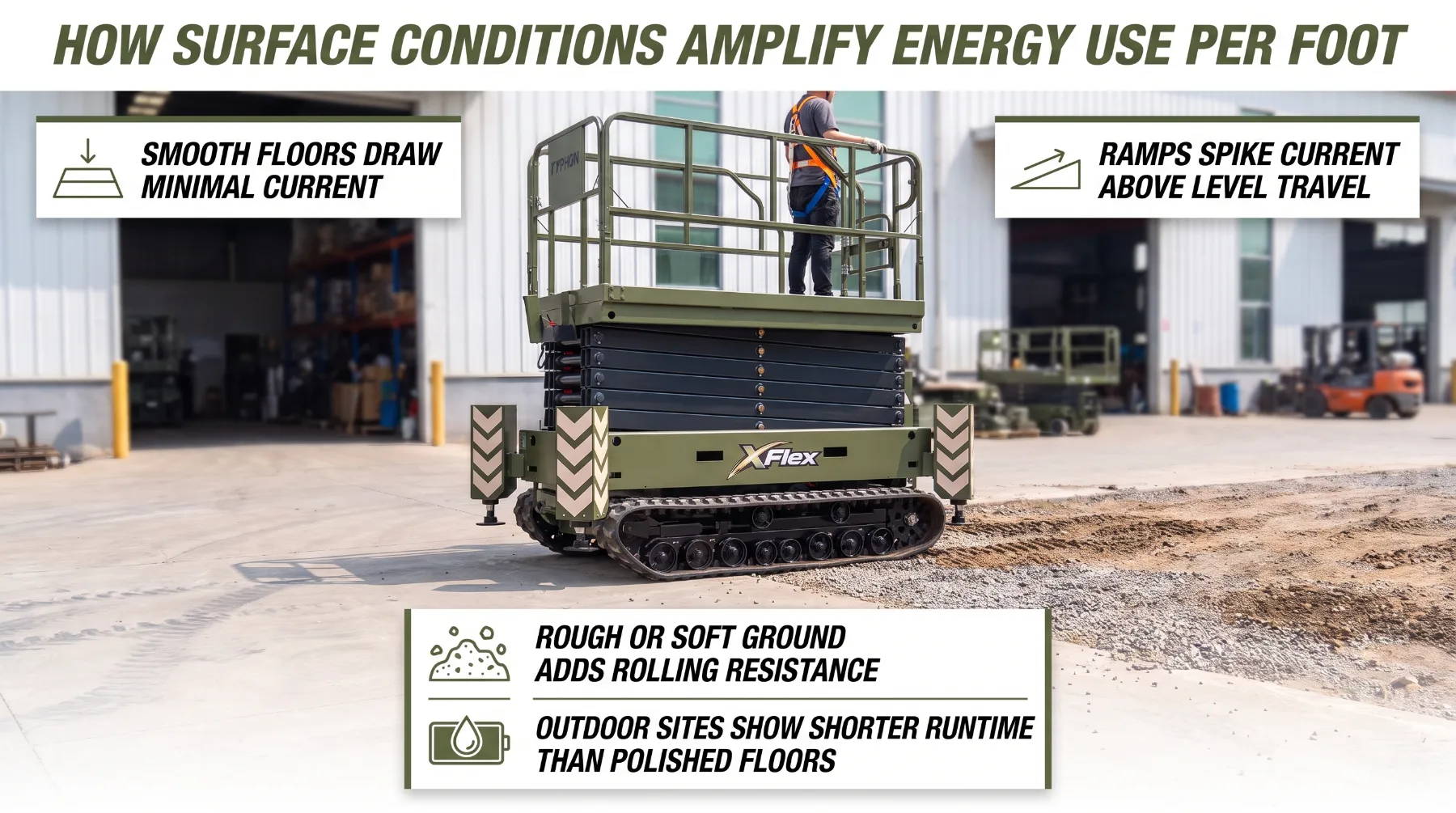
Not every foot of travel costs the same. The ground beneath the machine changes drive motor demand dramatically, and rough or sloped surfaces can more than double the energy burned over the same distance.
Smooth Floors vs. Ramps and Slopes
On smooth, level concrete, the drive motors work near their easiest. Rolling resistance is low, and the machine glides with minimal current draw. Ramps are the opposite extreme. Climbing a grade means the motors move the entire machine against gravity for the full length of the slope, spiking current draw well above level travel. A short ramp can cost more battery than a long stretch of flat floor.
Rough and Soft Terrain
Gravel, dirt, debris, and uneven surfaces add rolling resistance, forcing the motors to burn extra energy just to keep the machine moving. A lift working an unfinished outdoor site will consistently show shorter runtime than one gliding across a polished warehouse floor, even when both travel the same distance.
Think of it this way: two lifts drive 500 feet, but one crosses smooth concrete and the other climbs a ramp and rolls through gravel. The second machine can burn far more of its charge covering identical ground.
Key takeaway: Ramps and rough terrain sharply raise the current drawn per foot, so the surface a machine travels matters as much as the distance itself.
How Platform Load Weight Compounds the Drain
Distance and surface set the baseline, but platform load multiplies both. A heavier machine takes more force to get moving and more force to keep rolling, so the drive motors pull more current on every foot, and every ramp and rough patch hits harder still.
The relationship compounds. A lift loaded near its rated capacity, traveling a long distance, across uneven ground, faces the worst of all three factors stacked together. Each one alone shortens runtime; combined, they can drain a charge well before you expect.
That’s why loading discipline pays off beyond the lift itself. Carrying only the tools and materials the immediate task needs keeps every trip lighter and every foot cheaper. Staying within rated capacity protects both runtime and safety at the same time.
Key takeaway: Heavier platform loads raise drive motor current on every foot traveled, so load weight compounds travel distance and terrain to drain the battery faster.
The Relationship Between Drive Cycles and Battery Life
A drive cycle is a single episode of the machine moving, accelerating, traveling, and stopping. Each cycle includes a current spike at startup, because getting a stationary machine rolling demands more force than keeping it at speed. Frequent short repositioning moves stack those startup spikes on top of each other, so a lot of stop-and-go travel can drain more energy than the raw distance suggests.
How an operator drives matters too. Aggressive inputs, jamming the drive lever, jerky starts and abrupt stops, force sharp current spikes that smooth, deliberate travel avoids. Gradual acceleration and steady movement do the same work for less energy, and they reduce wear on the drive motors as a bonus.
Over the longer term, drive habits and travel demand also shape battery health. A pack repeatedly worked hard and deeply discharged ages faster than one run within a sensible range and charged fully between shifts. Protecting your daily runtime and protecting your battery’s service life go hand in hand.
Key takeaway: Frequent stop-and-go cycles and aggressive inputs spike current draw, so fewer, smoother drive cycles protect both daily runtime and long-term battery health.
Practical Tips for Reducing Travel Distance
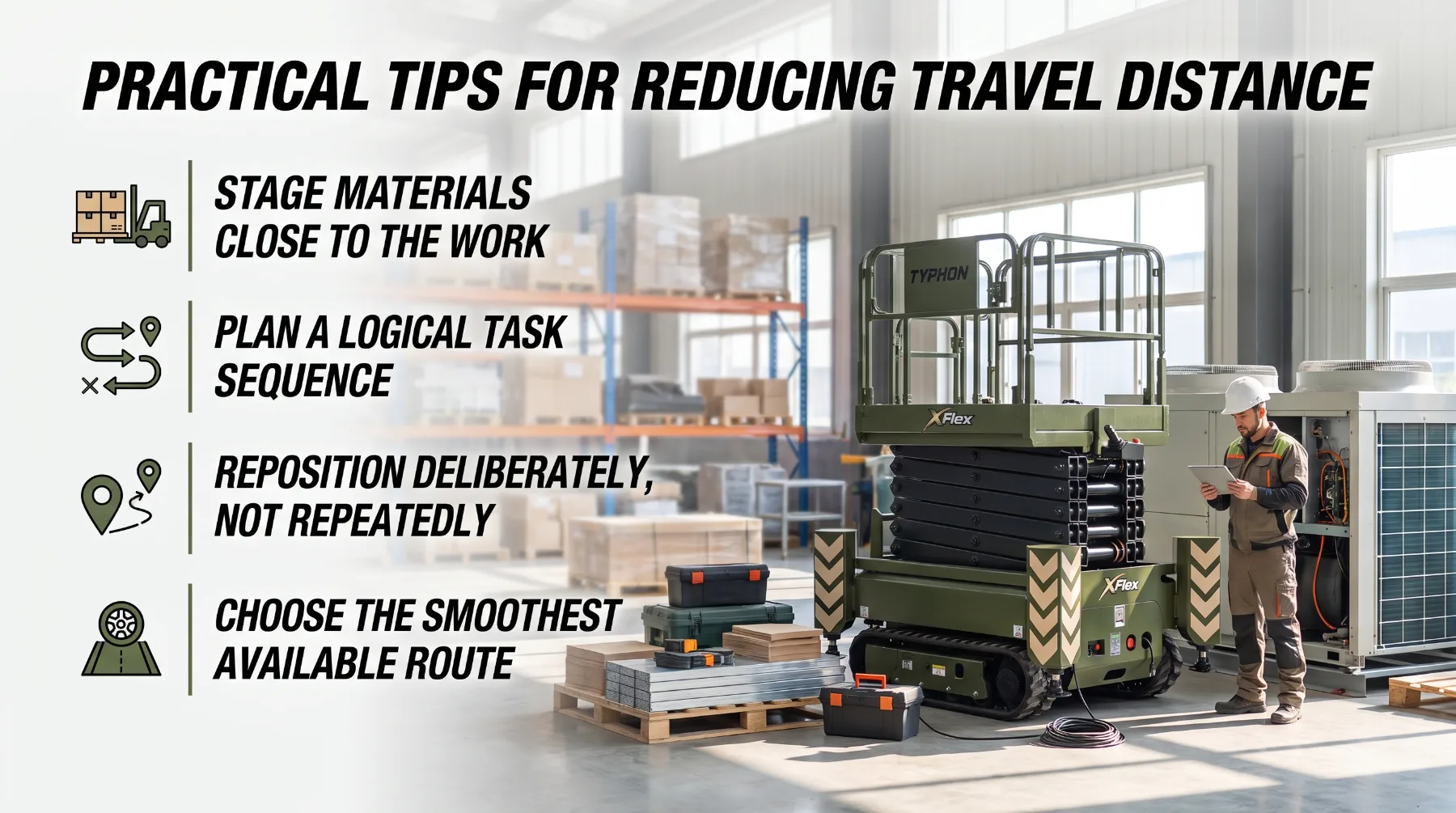
You control far more of your runtime than the battery’s rating alone suggests. A handful of deliberate habits cut unnecessary movement and stretch every charge:
- Stage materials close to the work. Position pallets, tools, and supplies near where they’ll be used so the machine drives shorter distances to reach them.
- Plan the sequence of tasks. Work through a logical path across the site rather than crisscrossing back and forth, which quietly doubles your mileage.
- Reposition deliberately, not repeatedly. Complete the work reachable from one position before moving, instead of nudging the machine every few minutes.
- Choose the smoothest route. When you must travel, favor level, firm paths over ramps and rough ground to cut the current each trip demands.
- Keep travel paths clear. Remove debris and obstacles so the machine isn’t forced onto rougher detours or fighting extra rolling resistance.
- Drive smoothly. Gradual acceleration and steady speed draw less current than hard, jerky inputs, and reduce machine wear too.
These steps cost nothing but attention, and together they recover a meaningful share of the runtime that careless travel quietly drains.
Key takeaway: Staging materials close, planning task sequence, repositioning deliberately, and driving smoothly all cut travel demand and extend runtime without slowing real work.
How to Plan Job Sites to Protect Runtime
Operators manage travel task by task, but fleet managers and site planners shape it at a higher level, and their decisions often matter more. A well-organized site cuts wasted movement before an operator ever touches the controls.
Start by mapping the work against the machine’s charging point and material staging areas. Clustering related tasks so a lift can complete a zone before relocating dramatically reduces long repositioning drives. Where possible, keeping travel paths level and firm, and minimizing the ramps a machine must climb, protects a real share of every charge.
Matching the right machine to the site helps too. A lift sized appropriately for its typical loads isn’t straining, and burning extra current, on every move. For larger operations, tracking each machine’s runtime over time reveals patterns: a lift that consistently falls short may be working in a poorly organized area rather than carrying a failing battery. That insight lets managers redesign the layout or reassign the machine before a short runtime disrupts a shift.
Key takeaway: Thoughtful site layout, clustering tasks, staging materials smartly, and minimizing ramps, protects runtime at a scale individual operators can’t, so planning is a fleet-level tool.
Conclusion
Travel distance is a major factor in electric scissor lift battery consumption because the traction motors draw electrical power throughout machine movement. Longer travel routes increase total energy use, while inclines, rough surfaces, and higher platform loads increase rolling and grade resistance, requiring greater motor torque and current. Frequent acceleration, stopping, and direction changes can further increase peak current demand, particularly when the machine is heavily loaded. Battery runtime can therefore be improved by staging materials near the work area, reducing unnecessary repositioning, planning efficient travel routes, and using smooth acceleration and speed control. Tire condition and pressure, drivetrain efficiency, battery condition, and terrain should also be considered because mechanical resistance and electrical losses affect the energy required for each trip. Evaluating travel distance, payload, surface conditions, grade, operating speed, and movement frequency as part of the overall duty cycle provides a more accurate estimate of battery runtime than battery capacity alone.
Frequently Asked Questions
Does driving my scissor lift around really use that much battery?
Yes. Drive motors continuously draw power while the machine is moving, making travel a significant part of battery consumption. Long travel distances, ramps, rough ground, and heavier loads increase energy use further. Planning efficient routes, staging materials nearby, and minimizing unnecessary repositioning can extend runtime without reducing productivity.
Why does my lift last longer on some job sites than others?
Runtime depends heavily on how much work the machine performs and the conditions it travels through. Smooth, level surfaces and short travel distances require less energy, while ramps, rough ground, cluttered layouts, and long routes increase motor demand. Platform load also affects consumption, so differences between sites are not necessarily a battery problem.
What’s the single most effective way to reduce travel-related battery drain?
Minimizing unnecessary travel usually provides the biggest return. Stage materials close to the work area, organize tasks to avoid repeated repositioning, and complete reachable work before moving. Smooth, level routes and controlled driving can further reduce energy use, helping the battery last longer across each shift.