

If you have ever stood on a undeveloped plot of land, staring at the dirt and visualizing a foundation, a septic system, or a new driveway, you have likely faced the classic heavy equipment dilemma: Do I need an excavator or a backhoe?
To the uninitiated, they look suspiciously similar. Both have a big yellow arm, a bucket with teeth, and enough hydraulic power to reshape the landscape. You see them both on construction sites, roadsides, and farms. But confusing these two machines is like confusing a surgeon’s scalpel with a high-quality Swiss Army knife. Both can cut, but one is a specialized instrument for deep, precise work, while the other is a versatile multi-tool designed to handle five different jobs before lunchtime.
Choosing the wrong machine for your project isn’t just a matter of semantics; it’s a mistake that costs time, burns excess fuel, and can leave you frustrated when the equipment can’t perform the specific maneuver the job demands.
This guide is going to bypass the dry spec sheets and dive into the real-world, dirt-under-the-fingernails differences between excavators and backhoe loaders. We will break down their strengths, expose their weaknesses, and help you decide which iron giant deserves a spot on your job site.
The Contenders at a Glance
Before we get into the heavy-duty comparison, let’s establish exactly what we are looking at.
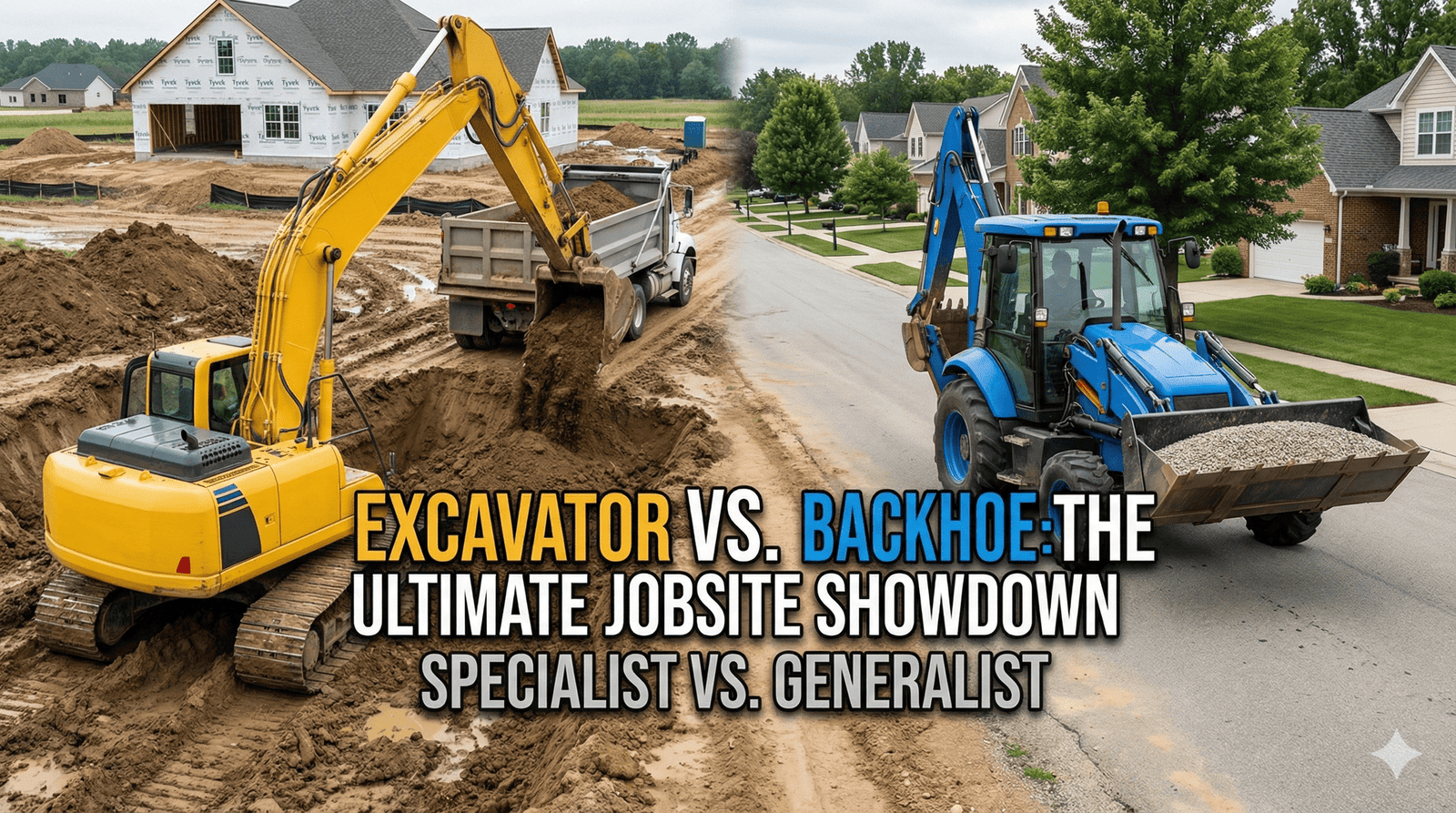
A Backhoe Loader (often just called a “backhoe”) is essentially a beefed-up industrial tractor. It runs on large rubber tires. On the front, it sports a large loader bucket for pushing dirt, lifting gravel, or loading trucks. On the back, it has the traditional digging arm (the hoe) with a smaller bucket. The operator sits in a central cab that swivels so they can face forward to use the loader or backward to use the hoe.
An Excavator is a machine built with a singular focus: digging. It typically runs on tracks (though wheeled versions exist), which support a chassis that can rotate a full 360 degrees. Mounted on this rotating platform is the cab, engine, and a massive boom and arm dedicated to heavy lifting and deep digging.
Think of it this way: The backhoe is a tractor that learned how to dig. The excavator is a digging arm that learned how to drive.
Deep Dive: The Excavator—The 360-Degree Specialist
When maximum digging productivity is the goal, the excavator is the undisputed king. Every inch of its design is optimized to move earth from below grade to above grade as fast as possible.
The defining characteristic of the excavator is its ability to swing. The entire “house”—the cab, engine, and boom—sits on a turret bearing that allows for continuous, unobstructed rotation. This sounds like a simple feature, but on a tight job site, it changes everything. An excavator operator can dig a bucket of dirt in front of the tracks, spin 180 degrees, and dump it into a truck behind them without ever moving the undercarriage.
This “dig-and-spin” capability means the excavator spends almost all its energy working. It doesn’t waste time driving back and forth to reposition itself just to dump a load.
Excavators also offer a staggering range of sizes. You have compact mini-excavators that can squeeze through a residential fence gate to dig a backyard pond, all the way up to massive mining behemoths that move hundreds of tons in a single scoop. This scalability means you can precisely match the machine’s power to the job’s requirements.
Furthermore, because they usually sit on tracks, excavators have a low center of gravity and excellent stability. The tracks spread the machine’s weight over a larger surface area, providing superior flotation. This allows them to work in wet, muddy conditions or on steep slopes where a wheeled machine would instantly bog down or tip over.
Deep Dive: The Backhoe Loader—The Master of Versatility
If the excavator is a specialist, the backhoe is the ultimate generalist. It is the machine you want when you don’t know exactly what the day will throw at you.
The backhoe’s primary advantage is right in its name: loader. That big bucket on the front isn’t an afterthought; it’s a primary tool. A backhoe can spend the morning digging a trench for utility lines using the rear hoe, and then spend the afternoon using the front loader to backfill that same trench, grade the surface flat, and load excess spoil into a dump truck.
To do those three tasks with an excavator, you would need the excavator to dig, and then a separate skid steer or compact track loader to handle the backfilling and grading. The backhoe is a “one-man band.”
Another massive advantage of the backhoe is mobility. Because they run on rubber tires and have a tractor-style powertrain, they can travel at significant speeds—often 20 to 25 mph—down paved roads.
If your operation involves working at multiple sites in a single day that are a few miles apart, the backhoe can simply drive there in traffic. An excavator, with its slow steel tracks that damage asphalt, would require a truck and heavy-haul trailer to move it across town. The time and cost savings of being able to “road” the machine are enormous for municipalities and utility contractors.
However, this jack-of-all-trades nature comes with compromises. A backhoe is generally not as powerful as a similarly sized excavator. It can’t dig as deep, and it can’t lift as much with the rear boom.
Head-to-Head: The Critical Differences
When you are trying to decide between the two, it usually comes down to four main factors: rotation, terrain, task variety, and raw power.
1. The Rotation Factor (Working Envelope)
This is the most significant operational difference. As mentioned, the excavator swings 360 degrees continuously. The backhoe’s digging arm, located at the rear, typically has a swing arc of about 180 to 200 degrees.
If you are using a backhoe to dig a trench and you need to dump the spoil pile far to your left, you might reach the limit of the boom’s swing. To dump it further, you have to physically drive the entire machine to a new angle. An excavator just keeps spinning. In highly confined spaces, like between two buildings, the excavator’s ability to rotate within its own footprint makes it the only viable option.
2. Terrain and Footprint
Where are you working? If it’s an established construction site with hard-packed dirt or pavement, the backhoe’s tires are fine. But if you are working in soft, undeveloped ground, mud, or hilly terrain, the backhoe’s tires act like anchors. They exert high ground pressure and will readily sink.
The excavator’s tracks provide the traction and flotation needed for ugly terrain. They sit higher, wade through deeper mud, and climb steeper grades with confidence. However, those tracks will tear up a client’s paved driveway in seconds, whereas the backhoe’s rubber tires will roll right over it without leaving a mark.
3. The Versatility Argument
Both machines accept a wide range of hydraulic attachments—hammers, augers, compactors, and thumbs. But they handle versatility differently.
The excavator is versatile sequentially. You take off the bucket and put on a hydraulic breaker to bust rock. Then you take off the breaker and put on a grapple to move land-clearing debris.
The backhoe is versatile simultaneously. It has two distinct ends ready to work at all times. You can use the front bucket to move a pallet of pipe, then immediately spin the seat around and use the rear hoe with an auger attachment to drill holes for fence posts. You don’t have to leave the cab to switch between pushing and digging functions.
4. Power and Depth
If the job requires deep digging—sewer systems, deep foundations, or large-scale commercial excavation—the excavator wins. The geometry of their boom provides greater digging depth and higher breakout force than a comparable backhoe. While large backhoes are powerful, they eventually hit a depth limit where they lose efficiency, a depth where a mid-size excavator is just getting started.
Making the Call: Real-World Scenarios
Let’s apply this to the real world. Which machine fits which job?
Scenario A: The Suburban Utility Repair A water main has burst in a suburban street. You need to get there fast, break through the asphalt, dig down six feet to the pipe, fix it, backfill the hole, and clean up the mess.
The Winner: The Backhoe. It drives itself to the scene on the road. It uses the rear bucket to dig the hole. Once the repair is done, it uses the front loader bucket to push the dirt back in and level the street. It does the whole job solo.
Scenario B: The New Home Foundation You are clearing a wooded lot and digging a large, deep basement for a new house. The ground is uneven and soft due to recent rain.
The Winner: The Excavator. You need the tracks to navigate the soft, uneven terrain without getting stuck. You need the 360-degree swing to aggressively clear trees and stack them quickly. Most importantly, you need the digging depth and power to excavate a large basement and load dump trucks efficiently without constantly repositioning the machine.
Scenario C: The Farm & Ranch Hand You own a large property and need a machine for practically everything: fixing fences, cleaning out ditches, moving hay bales, maintaining gravel roads, and occasionally digging out a stump.
The Winner: The Backhoe. The variety of tasks plays to the backhoe’s strengths. The front loader will likely see as much use as the rear hoe. The ability to drive quickly across pastures to different corners of the property makes it invaluable for maintenance work.
Conclusion
Deciding between an excavator and a backhoe isn’t about finding the “better” machine. It’s about honestly assessing the reality of your daily work.
If your days are filled with diverse tasks, significant travel between sites on paved roads, and a need to both push and dig material, the backhoe loader remains the undisputed champion of versatility. It is the reliable utility player that ensures you are never totally unprepared for a job.
But if your work demands maximum production, deep digging in difficult terrain, or working in confined spaces where rotation is key, the specialized focus of the excavator will outperform the backhoe every time.
Don’t buy the machine you want to drive; buy the machine your job site is asking for.