
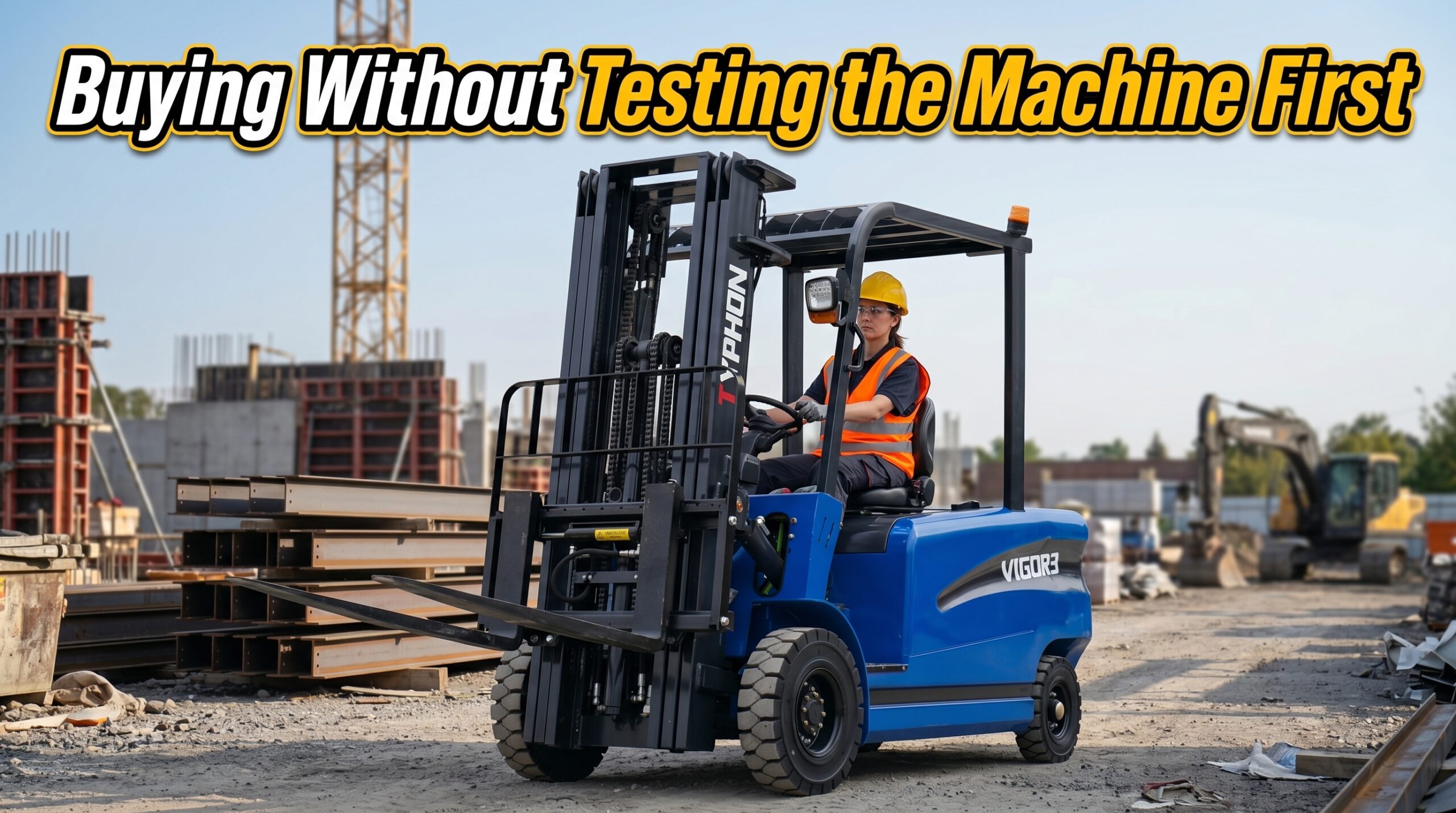
Acquiring heavy machinery represents one of the most substantial capital investments your contracting business will execute. Relying solely on glossy dealership brochures and digital specification sheets exposes your company to massive financial risk. A machine that looks perfect on a printed page frequently fails to deliver the expected results on an actual, demanding job site.
To secure your working capital and maintain peak operational efficiency, you must validate every purchase in the real world. Skipping the physical demonstration process directly threatens your project timelines and your bottom line.
This guide breaks down exactly why you must physically evaluate machinery prior to signing a purchase agreement. We will explore the hidden risks of blind purchases, examine a detailed forklift scenario to illustrate common pitfalls, and outline the precise elements your crew must evaluate during a field trial. By understanding exactly how to test equipment before buying, you ensure every new asset actively drives your company’s profitability and success.
The Hidden Dangers of Skipping the Physical Demo
Equipment manufacturers design their specification sheets to highlight maximum capabilities under perfect, controlled conditions. Your construction sites rarely offer perfect conditions. When you base your purchasing decisions entirely on these theoretical numbers, you assume a dangerous level of operational risk.
Theoretical Power vs. Practical Application
A specification sheet might state that a specific compact track loader provides exceptional breakout force and lifting capacity. However, that document cannot tell you how the machine balances when carrying a heavy load over uneven, muddy terrain. It cannot reveal whether the hydraulic system lags when you attempt to lift a heavy concrete barrier while simultaneously turning the machine.
When you fail to test equipment before buying, you frequently end up with a machine that struggles to perform your specific daily tasks. An underpowered or poorly balanced machine forces your operators to work slower, instantly reducing your daily productivity. This reduced efficiency eats away at your tightly calculated project margins, transforming what should be a profitable contract into a financial loss.
The Immediate Depreciation Trap
If you purchase a machine blindly and realize it does not fit your operational needs, you face a brutal financial reality. You cannot simply return heavy machinery to the dealership for a full refund. The moment you take delivery of a new machine, it suffers from rapid initial depreciation.
If you must sell the wrong machine just three months after purchasing it, you will absorb a massive financial loss. Taking the time to test equipment before buying completely eliminates this expensive trial-and-error approach to fleet management. You verify the exact capabilities of the machine upfront, ensuring it seamlessly integrates into your current operations.
Case Study: The Cost of Buying a Forklift Blind
To truly understand the operational disasters caused by skipping the demonstration phase, we must examine a specific, common equipment acquisition. Material handling remains a critical component of nearly every commercial construction project. Contractors frequently purchase forklifts to move heavy pallets of block, roofing materials, and structural steel across their sites.
Ignoring the Working Environment
Imagine a contractor who secures a massive contract to build a commercial retail center. They quickly scan a dealership website, find a forklift with a 10,000-pound lifting capacity, and purchase it immediately. They ignore the demonstration process entirely because the lifting capacity technically matches their heaviest pallets.
When the forklift arrives at the active construction site, the crew immediately encounters severe problems. The contractor purchased a warehouse forklift equipped with smooth, cushion tires designed strictly for flat concrete floors. The construction site still consists of loose gravel, deep rutted dirt, and uneven slopes. The heavy warehouse forklift instantly sinks into the gravel, spinning its smooth tires helplessly.
Because the contractor failed to test equipment before buying, they purchased a machine entirely unsuited for their physical environment. They actually needed a rough-terrain forklift equipped with aggressive pneumatic tires and high ground clearance. Now, they must rent a proper machine at a premium daily rate while simultaneously making finance payments on the useless warehouse model stuck in the mud.
Misjudging Mast Height and Visibility
Beyond tire specifications, forklift performance relies heavily on mast design and operator visibility. If our hypothetical contractor had requested a physical demonstration, their lead operator would have climbed into the cab.
During a proper demo, the operator would attempt to lift a simulated load to the exact height required for the current project. They might discover that the specific mast design on this forklift creates a massive blind spot exactly where they need to see the tips of the forks. This poor visibility forces the operator to lean awkwardly outside the protective cage, creating a severe safety hazard and drastically slowing down the material handling process.
Testing the forklift with a real load instantly reveals these critical ergonomic and engineering flaws. It allows you to pivot your purchasing strategy toward a different brand or a different mast configuration that actually protects your crew and accelerates your workflow.
What a Proper Equipment Demo Reveals
““““““““““““““““`
A physical demonstration should never consist of a simple five-minute drive around the freshly paved dealership parking lot. To extract genuine value from the test, you must push the machine hard. You need to simulate the exact conditions your crew faces daily.
Operator Comfort and Ergonomics
Your heavy equipment operators spend up to ten hours a day inside the cab. Their physical comfort directly dictates your job site productivity. A cramped cab, poorly placed joysticks, or an inadequate climate control system rapidly accelerates operator fatigue.
When you test equipment before buying, you must mandate that your primary operators spend significant time in the seat. They need to evaluate the adjustability of the air-ride suspension, the intuitiveness of the primary controls, and the overall noise levels inside the cab. If your operators fight the machine’s controls or struggle to stay comfortable, their daily material output will drop significantly.
Real-World Hydraulic Responsiveness
You cannot judge hydraulic performance by reading a flow rate on a brochure. You must feel how the system responds under heavy, sustained pressure.
Bring your heaviest standard attachment to the demonstration, or ask the dealer to provide a comparable tool. Connect a heavy-duty hydraulic breaker or a massive vibratory compactor to the machine. Run the attachment at full capacity and monitor the machine closely. Does the engine bog down? Do the auxiliary hydraulics overheat? Does the boom lift at a painfully slow speed while the attachment runs? Testing these specific parameters ensures you purchase a machine with the raw hydraulic muscle necessary to power your existing inventory of tools.
Job Site Maneuverability
Construction sites constantly evolve, frequently forcing your operators to work in incredibly tight, congested spaces. You need to know exactly how a machine handles when surrounded by structural steel, deep trenches, and other heavy equipment.
During your physical test, set up tight barricades or traffic cones to simulate your most restrictive job sites. Evaluate the machine’s exact turning radius and its tail swing profile. If an excavator features a massive conventional tail swing, your operator might accidentally crush a concrete formwork while rotating the cab. Testing maneuverability prevents costly job site accidents and property damage.
How to Structure Your Equipment Test
To maximize the value of your equipment evaluation, you must follow a disciplined, structured approach. Treat the demonstration as a critical component of your official procurement process.
First, demand that the dealership deliver the machine directly to your active job site for a multi-day trial. Reputable dealerships understand that serious contractors need to see the equipment move actual dirt on their own terms. If a dealer refuses to accommodate an on-site demonstration, you should immediately take your business elsewhere.
Second, test the machine against your specific production benchmarks. If your standard 20-ton excavator loads a commercial haul truck in exactly three minutes, time the new machine performing the exact same task. You need hard, actionable data to justify the massive capital expenditure.
Finally, involve your heavy equipment mechanics in the demonstration phase. Have them open all the service compartments and evaluate the engine bay layout. If your mechanics cannot easily access the oil filters, fuel separators, or daily grease points, your preventative maintenance schedule will suffer. A machine that proves nearly impossible to service will inevitably cost you thousands of dollars in extended labor hours over its lifespan.
Conclusion
Securing highly capable, reliable machinery dictates the ultimate success and profitability of your contracting business. You cannot afford to make acquisitions based on assumptions, brand loyalty, or carefully crafted marketing materials. You must demand tangible proof of performance before you commit your hard-earned working capital.
By enforcing a strict policy to test equipment before buying, you actively protect your fleet from underperforming assets. Take the time to put every potential new machine through a rigorous, real-world evaluation. Let your operators judge the comfort, let your mechanics evaluate the serviceability, and let the raw production data drive your final decision. When you validate your machinery choices on the actual job site, you build a powerful, resilient fleet guaranteed to conquer your most demanding commercial contracts.