

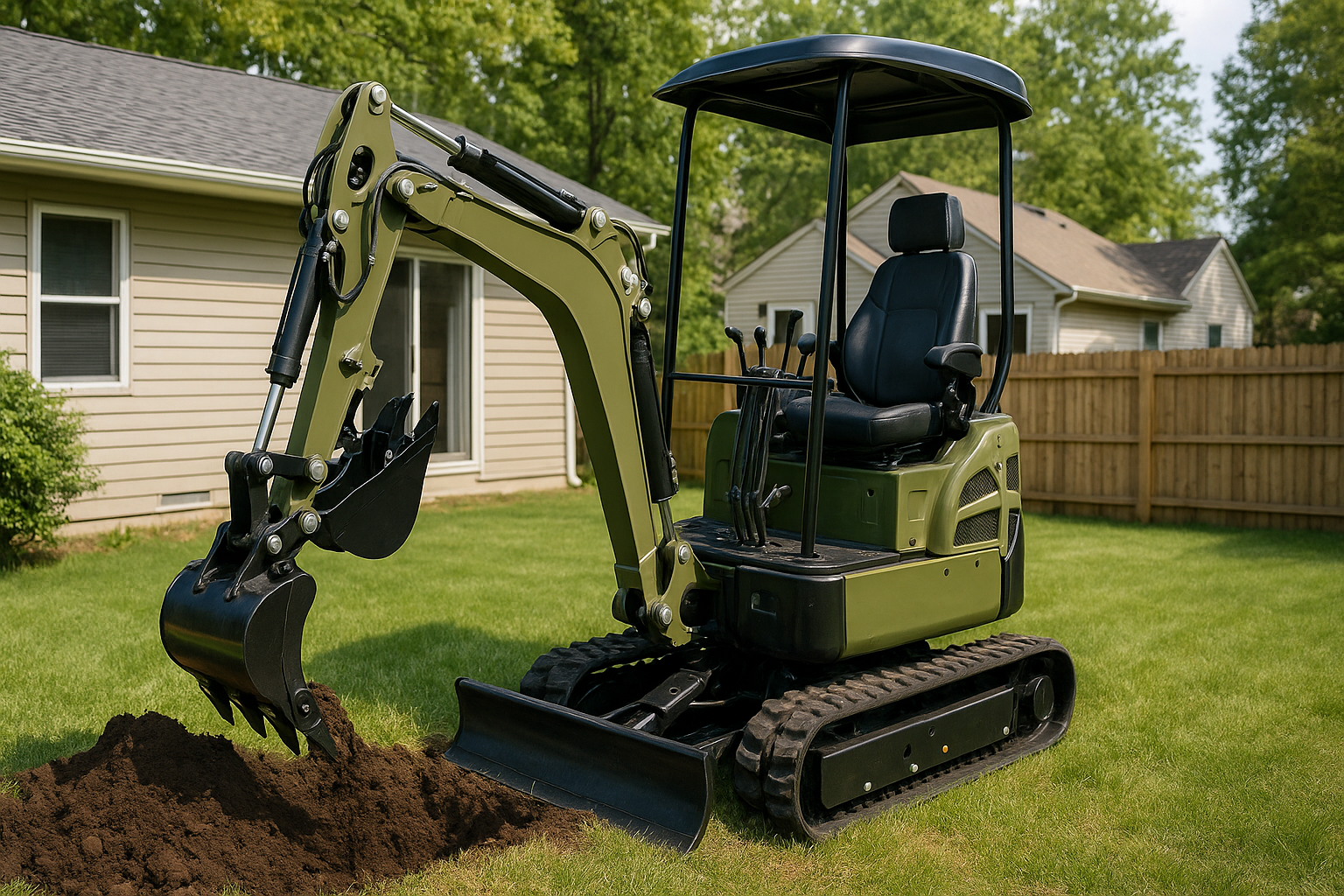
One of the most amazing transformations of the mini excavators is their way of proceeding, which is a reflection of the requirements of the construction industry. Initially, mini excavators were introduced at the end of the 20th century, and the main concept was to come up with a feasible and convenient solution for the large one.
The company had the mini excavators produced for the closely constructed places, such as the cities’ construction sites, residential areas, and take-care-of-the-earth projects.
At first, they hardly had. Nevertheless, as the tech got better and as the earth-sided work changed, also the mini excavators’ change happened. Over the years, the producers have focused on upgrading the functions of mini excavators, leading to significant advancements to the hydraulic systems, engine efficiency, and overall performance. With the powerful engines and upgrades of the hydraulic systems, these machines can now perform a wider range of tasks.
Thus, mini excavators are the most fortunate people in the construction industry who can effortlessly resolve the problems that arise. The development of these machines has not only altered the ways of project execution in the construction field but also influenced the present and future designs of other construction machines.
Key Takeaways
- First of all, the mini excavators’ evolution is characterized by their increased compactness, versatility, and efficiency in construction projects.
- Out of the features of mini excavators, the most significant ones are the ease of movement, the minimal disruption of the site, and the lower operating costs.
- The latest mini excavators have introduced high-tech features such as an advanced hydraulic system, improved fuel efficiency, and enhanced operator comfort.
- The influence of the new mini excavators on the efficiency in construction is evident through a considerable shortening of the project timelines and a rise in productivity.
- Mini excavators can also help the environment as they release fewer pollutants, consume less fuel, and cause less site disruption than large machines.
The compactness of mini excavators is definitely one of the major factors that resulted in their increased usage in construction projects, as it makes them suitable for the places where bigger machines cannot reach because of lack of space.
This factor alone has the potential to completely change the methods of construction in cities where space is always a problem. As an illustration, in the case of home renovations or utility installations at a crowded neighborhood, mini excavators are capable of infiltrating through the narrow alleys as well as existing buildings without making a big noise.
Their capability of working in such confined spaces also makes them the best choice for the job of digging trenches for plumbing or electrical lines which require a high level of precision and accessibility.
In addition to their size, the versatility is another characteristic by which mini excavators can be distinguished. Those machines with different attachments like buckets, augers, and hydraulic breakers can do different things in the same place where the job is. This versatility is what the work of multiple briefcases with a time-saving and cost-saving principle is.
For instance, while using a mini excavator for digging a foundation, a contractor can quickly switch to an auger for post-hole digging without the need to bring in additional machinery. Moreover, the multi-functionality also leads to the productivity elevation and at the same time, it reduces the logistical problems of machine transport and management.
Innovative Features of New Mini Excavators
New mini excavator models feature a long list of cutting-edge features that raise both their effectiveness and user-friendliness. One significant change is the adoption of advanced hydraulic systems that offer better control and energy-saving options. The workers can change the flow and pressure of the hydraulic fluid; hence, they achieve more precise moves and less fuel consumption.
For instance, some modern mini excavators are equipped with variable flow hydraulics which can change the flow automatically based on the attachment being used and, thus, the performance is optimized for the specific task.
Furthermore, the smart technology implementation in mini excavators is another milestone. Most of the latest models are equipped with telematics systems that provide real-time data about the machine’s performance, location, and maintenance needs.
Such a system enables the fleet managers to have a remote view of the equipment; hence, it is always used at its best, and not too much time is lost due to maintenance.
Besides, some safety features like automatic shut-off systems and enhanced visibility due to improved cab design have also been added in some mini excavators. All these changes not only facilitate the smooth working of the tasks but also safety improvement for the workers and the people around.
How New Mini Excavators are Improving Efficiency in Construction
New mini excavators are the major contributors to the efficiency of the construction by their increased performance and streamlined operations. Their powerful engines along with the advanced hydraulic systems are the main factors why these machines can do the work quicker than it was done before.
For example, in modern mini excavation, operating is done at a faster cycle, e.g., digging or lifting, and that is why it requires much less time to be of the whole project. This is an example of the coming value that an efficiency increase may have in construction markets that are ultra-competitive where time is often regarded as money saved.
The merely possibility of quickly interchanging the various attachments is also great field work efficiency improvement. Due to quick coupler technology advancements, an operator can fix another tool on the machine in a matter of minutes without requiring extra assistance or tools.
Thus, construction crews are enabled to very effectively utilize this flexibility to keep up with the ever-changing demands of the project hence, they hardly encounter any wait times due to equipment changes. For illustration, when a project is abruptly shifted from digging an area to leveling it, the operator can just as well change the bucket with the blade and work can proceed without a break.
The Environmental Benefits of Mini Excavators
Energy-efficient mini excavators that are less polluting are a very big concern for the construction industry that is trying to lower its CO2 emissions. Among the most significant reasons for it is its fuel efficiency in comparison with big machines.
Smaller engines and lighter machines lead to less fuel consumption, thus in the case of mini excavators, it is almost half as much as in the case of big machines, and consequently, half the emissions are produced per hour of operation. This has a lot to do with that in cities where the quality of the air is a problem; this practice is an important preventative measure against pollution.
Meanwhile, most of the producers have shifted their focus to the production of renting-friendly models that meet strict emissions regulations. The mini-excavator engine is a good example of this. It meets Tier 4 emissions requirements and hence is considerably less of a pollutant without the need to sacrifice power and results.
Following their compactness, mini excavators are usually surrounded by less land that needs to be disturbed during their work, thus, not only are the ecosystems being preserved but also there is less soil erosion. By choosing mini-excavators instead of the large ones, builders are practicing sustainability and at the same time, fulfilling their construction targets.
Safety Considerations When Operating Mini Excavators
In the case of dealing with huge and dangerous machines like mini excavators, it is very important that the highest safety comes first. The workers not only have to be trained in the operation of the machine but also in the knowledge of its troubles and features related to security.
A very important safety point is the support for operation checks that the workers need to do before starting the machine. It includes replenishing and inspecting fluid levels, checking for leaks on the hydraulic hoses, and also, ensuring that all safety gadgets are in good working order. People who do this checking regularly, have an opportunity to identify small problems which, if not checked, can lead to accidents or machine breakdown.
Besides that, getting enough knowledge of safety measures and ways of performing these will substantially reduce the risk on the construction sites. The workers should know the correct, safe performance of loading and unloading procedures, as well as navigation over the uneven ground.
Furthermore, using the appropriate personal protective equipment (PPE) such as hard hats, gloves, and safety clothing is a must if one wants to be sure of safety at the location.
Besides providing protection for the operators, strict safety regulations also act as shields for the other workers and even bystanders, thus, can prevent them from being the victims of potential hazards associated with mini excavator operations.
The Versatility of Mini Excavators in Various Construction Applications
The major point of mini excavators is that they are tremendously versatile and can be utilized in various different construction projects. The fact that these machines can do many jobs makes them the ultimate workers at the places where different jobs have to be done.
As an example, even though they are mainly targeted at the task of digging for the construction of the building’s foundation or trenches, these machines can also be employed in the garden sector for the purposes of leveling and preparation of the soil. Such versatility provides contractors with the opportunity to use one machine instead of multiple ones for different purposes.
Apart from the excavation work that has been already mentioned, mini excavators can perform tasks in specialized fields, e.g., utility installation and demolition. Their small size enables them to go where the big ones cannot, i.e., places with limited space.
Therefore, when laying underground water or gas pipes in the cities, developers can depend on the nimbleness of mini excavators, which allows them to work around the existing infrastructure without causing big disruptions.
The same can be said for demolition where mini excavators are equipped with precision tools and can be used to dismantle the buildings that border the target structures and also to minimize debris scatter, hence the safety of workers and the environment can be guaranteed.
Future Trends in Mini Excavator Technology
The mini excavator technology of the future is expected to have numerous emerging trends to reshape the industry due to the rapid technological advancement. The foremost of these trends is the significantly higher level of integration of automation and robotics into the mini excavator design.
The companies that manufacture them are working on ways to equip their products with features of independence so that the machines could finish the jobs with less direct human guidance. Shortly after, developers anticipate that such an idea will result in a vastly enhanced production.
Another trend is the rise of electric mini excavators as a part of a bigger plan to create eco-friendly construction equipment. The electric models promise reduced emission of pollutants and lower operating costs as a result of less fuel consumption and fewer maintenance needs typical of traditional diesel engines. Without battery technology improving, electric mini excavators may not be able to rival regular ones in terms of power or performance.
Besides that, the future of mini excavator technology may be largely dependent on the connectivity advancements. By integrating IoT (Internet of Things) capabilities, it will be possible to instantly access the performance and condition data of the machine from which the data analytics can infer the most suitable maintenance schedules and efficiency improvements.
Not only will this be a tremendous help in fleet management, but it will also make a great contribution to safer working conditions as it will be possible to foresee the risky situations or equipment malfunctions in advance instead of finding them when they escalate into severe problems.
To summarize, the transformation of mini excavators has made them the indispensable tools of the construction industry. Despite their smallness, these machines provide unprecedented accessibility to the narrow areas, and due to their versatility, they can be used for different tasks in an efficient way.
With continued improvements in technology and design, mini excavators will certainly be one of the most influential factors in the future of construction practices worldwide.